- Past Event: 11th May 2026
- Industry Insights
Fertiliser volatility is a UK problem: Better nutrient recovery must be part of the answer
The global fertiliser market is under pressure again.
Energy prices, geopolitical instability, shipping disruption and supply risk are affecting the cost and availability of nitrogen, phosphate and potash fertilisers. The World Bank has projected fertiliser prices to increase by 31% in 2026, driven by a 60% rise in urea prices. It also warned that fertiliser affordability could fall to its weakest level since 2022, putting pressure on farm incomes and future crop yields.
For the UK, this is not a distant global issue. It is a food production and input resilience issue.
The UK is estimated to produce around 40% of its nitrogen fertiliser requirement, with the remaining 60% reliant on imports. AHDB has also reported that GB fertiliser prices rose sharply between February and March 2026, including increases of 25% for UK-produced ammonium nitrate, 29% for imported ammonium nitrate, 36% for granular urea and 13% for liquid urea ammonium nitrate.
That creates three clear challenges:
- UK agriculture remains exposed to global shocks.
When fertiliser prices rise, farm margins come under pressure. Farmers and growers cannot easily plan when one of their core inputs is linked to gas prices, international conflict, shipping routes and import availability. - Conventional fertiliser carries a carbon cost.
Synthetic and mineral fertilisers remain essential to modern agriculture, but their production and transport can be energy intensive. This is not about pretending conventional fertiliser can disappear. It cannot. The real opportunity is to reduce exposure, use nutrients more efficiently and create lower-carbon alternatives where the agronomy and economics make sense. - The UK AD and biogas sector has a digestate management challenge.
Digestate contains valuable nutrients, but it is produced in large volumes and still has to be stored, moved, treated, spread or otherwise managed. That creates cost, logistics pressure, landbank dependency, odour risk, nutrient loading concerns and regulatory responsibility. In England, the Environment Agency’s Anaerobic Digestate Resource Framework sets out when certain digestate products may meet end-of-waste requirements, showing the increasing importance of quality, control and evidence in digestate use.
This is where better nutrient recovery matters.
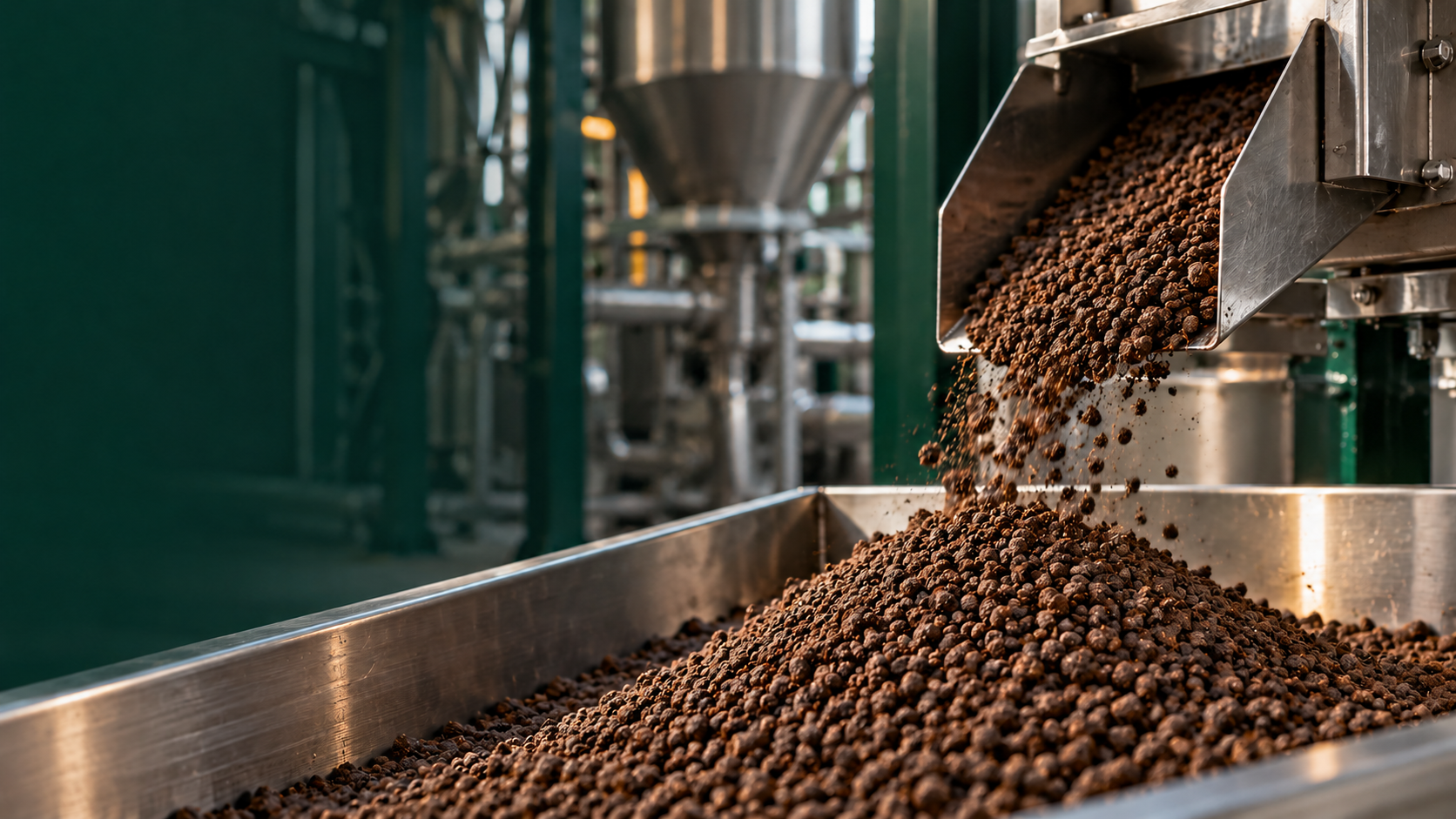
Our H2OPE technology is designed to process digestate at source and recover useful value from it. Rather than treating digestate only as a material to manage, H2OPE separates and processes it into controlled outputs: a recovered fertiliser product and a treated liquid output designed to meet site-specific discharge, reuse or onward management requirements.
The recovered fertiliser product is central to the opportunity, in terms of environmentally, financially and operationally.
Based on our current product development and supporting nutrient analysis, H2OPE can produce recovered-based NPK fertiliser grades in the region of 7-2-9 to 11-2-7 – we have produced higher – subject to the nutrient profile of the incoming digestate and any final product formulation requirements. SEM’s process is designed to recover up to 99% of nutrients from the digestate stream, supported by internal testing and mass-balance evidence, with final performance dependent on feedstock composition, system configuration and site-specific operating conditions.
That matters because the product must stand on its own merits. Farmers, growers, distributors and agronomists need confidence in nutrient value, consistency, certification, handling, crop suitability and field performance. A recovered fertiliser is only valuable if it is practical, compliant and capable of supporting real agronomic decisions.
The treated liquid output must also be judged properly. Treatment alone is not enough. Water quality, nutrient levels, suspended solids, pH, conductivity and site-specific permit requirements all matter. The objective is to reduce nutrient load, improve liquid management options and create a controlled output pathway that is more predictable than conventional digestate handling.
The carbon opportunity is significant, but it must be stated carefully.
Based on SEM’s current working assumptions, H2OPE recovered fertiliser could offer an indicative carbon reduction of around of up to 2.0 tonnes of CO₂e per tonne of finished fertiliser product (typical range between 1.3 – 1.7), when compared with selected conventional synthetic or mineral fertiliser alternatives. The greatest carbon benefit is achieved where the recovered product can directly displace part of the need for imported or conventionally manufactured fertiliser. The final saving will depend on product formulation, energy source, transport distance, additive use, site operation, nutrient concentration and the fertiliser product being displaced.
Even on a cautious basis, the potential impact is material.
For every 10,000 tonnes of recovered fertiliser produced, that could represent an indicative saving of 13,000 to 20,000 tonnes of CO₂e, depending on the final product and comparison basis. At larger deployment scale, this moves beyond a single-site efficiency gain. It becomes part of a wider UK opportunity: lower-carbon nutrient production, improved digestate management, reduced reliance on imported fertiliser and better use of resources already being produced within the country.
The commercial case is different for each customer group:
- For AD and biogas operators, H2OPE has the potential to reduce digestate storage, transport, spreading, landbank and compliance pressures. It can help turn a high-volume operational challenge into a more controlled resource recovery pathway.
- For fertiliser buyers, the value sits in the recovered product itself: nutrient content, consistency, availability, certification, price, carbon profile and practical use in the field.
- For the wider market, the opportunity is resilience.
The UK does not just have a fertiliser price problem, there is a fertiliser resilience problem, in terms of both local and global supply. It will remain exposed to energy markets, politics and shipping risk. At the same time, the UK is already producing large volumes of nutrient-rich material through the AD and biogas sector.
The better answer is not to wait for fertiliser markets to stabilise. The future of fertiliser will not be built on imports alone. It will be built by recovering more value from the resources already in front of us – safely, consistently and commercially.